
Status: Competition Finalist
INTRODUCTION TO THE COMPETITION AND LET’S BUILD MY SCHOOL
The project was developed in response to the international competition launched by Let’s Build My School (LBMS), a UK-registered charity committed to constructing educational infrastructure through the use of natural materials and local resources. The mission of LBMS is to act as a social catalyst, transforming the construction site into an opportunity to trigger circular micro-economies and empower local communities. The objective for the Djilakh site was to define a secondary school that harmonizes high environmental comfort with a resilient, low-maintenance construction system.


MASTERPLAN AND CLIMATE STRATEGY
The architectural approach does not begin with the definition of a volume, but with a primary act of protection driven by the climate. The masterplan proposes a fan-shaped layout specifically designed to capture prevailing dry-season and Harmattan winds, fostering constant natural cross-ventilation.
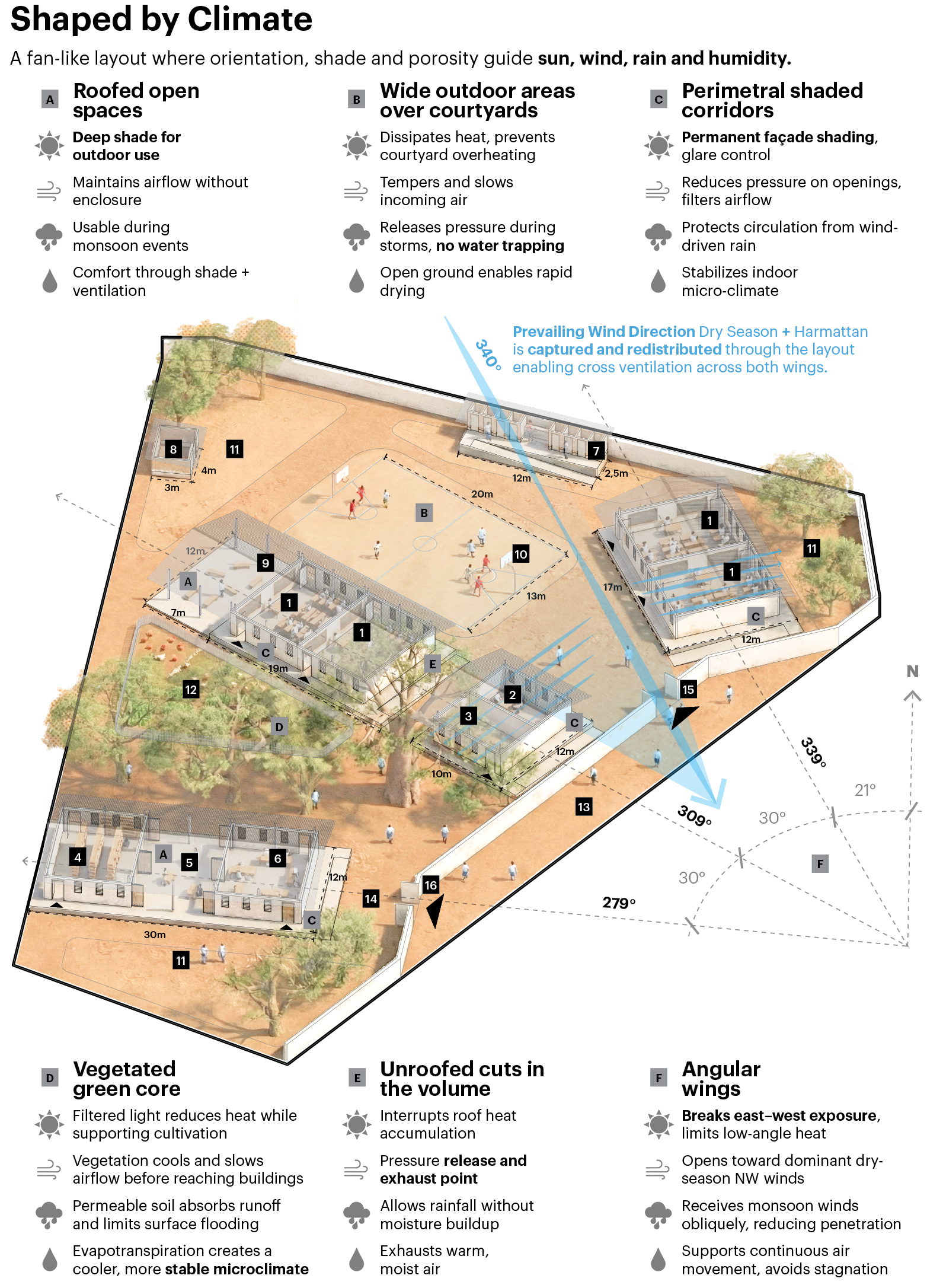

The system is inherently incremental: the spatial grid is conceived to allow the community to initially build even a single classroom, allowing the framework to expand over time without compromising the environmental performance or the coherence of the collective space. A central green core serves as a thermal lung, while angular wings reduce direct solar exposure and define wide, shaded perimeter corridors for circulation.
THE “ROOF-FIRST” ENGINEERING: TECHNIQUE AND SUSTAINABILITY
The technical heart of the proposal is the “Roof-First” strategy, which intentionally inverts the traditional construction sequence to prioritize early environmental protection. By erecting an independent, lightweight steel skeleton as the very first step, the site is immediately transformed into a shaded and ventilated workshop. This approach provides local masons with dignified working conditions, shielding them from the scorching sun and torrential rains as they proceed with the subsequent construction of the earth walls. This structural decoupling also ensures long-term flexibility, as the classroom enclosures remain non-load bearing and can be reconfigured or expanded in the future without affecting the integrity of the primary shelter.
To avoid reliance on heavy machinery or specialized imported beams, the structure utilizes Hybrid Open-Web Trusses fabricated entirely on-site. These are constructed by welding standard Ø14 mm reinforcement bars to steel angles, creating lightweight components that can be manually hoisted into place. This efficient geometry spans the full width of the classroom, removing the need for central pillars and offering a column-free internal volume that adapts to diverse pedagogical needs.
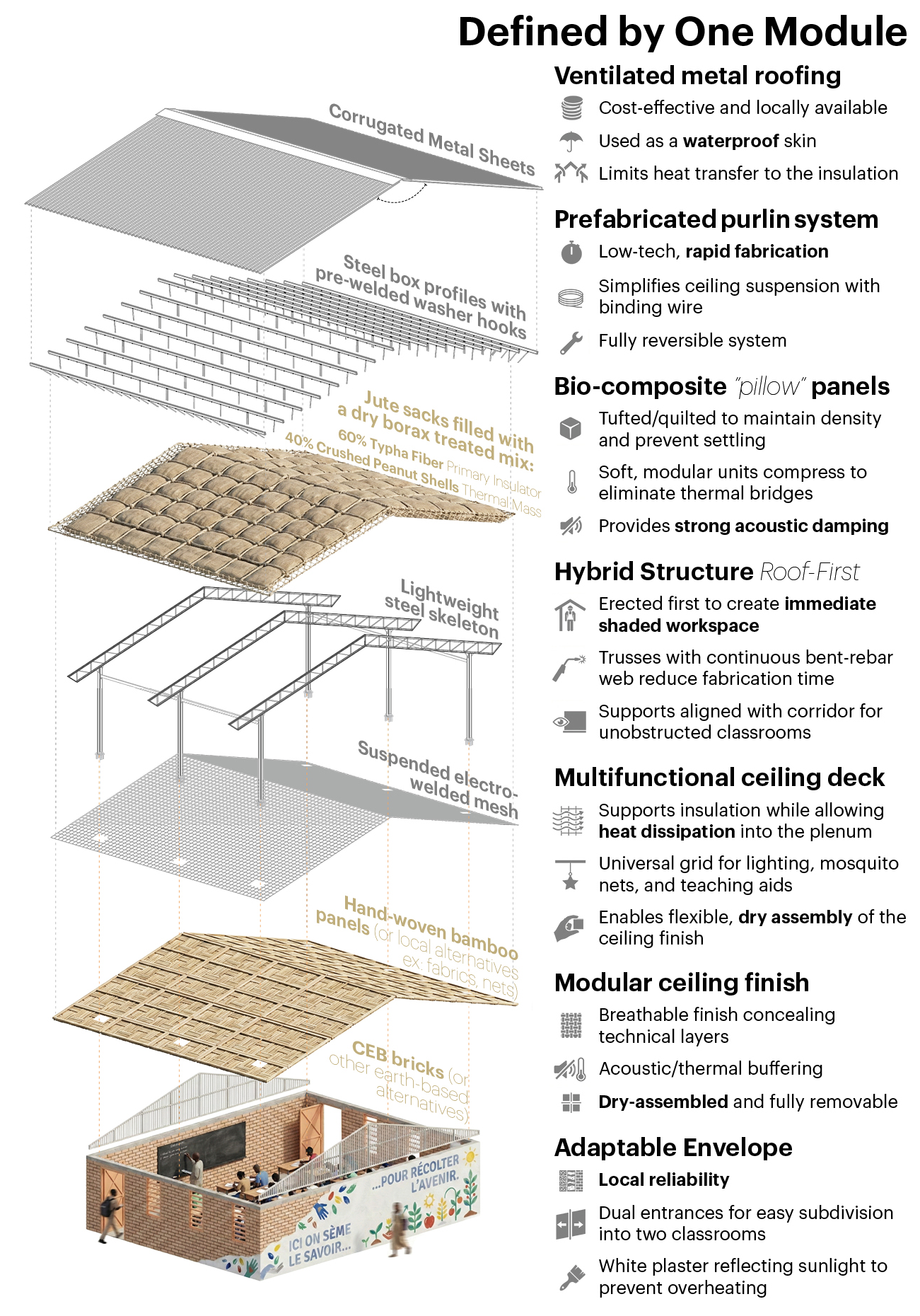
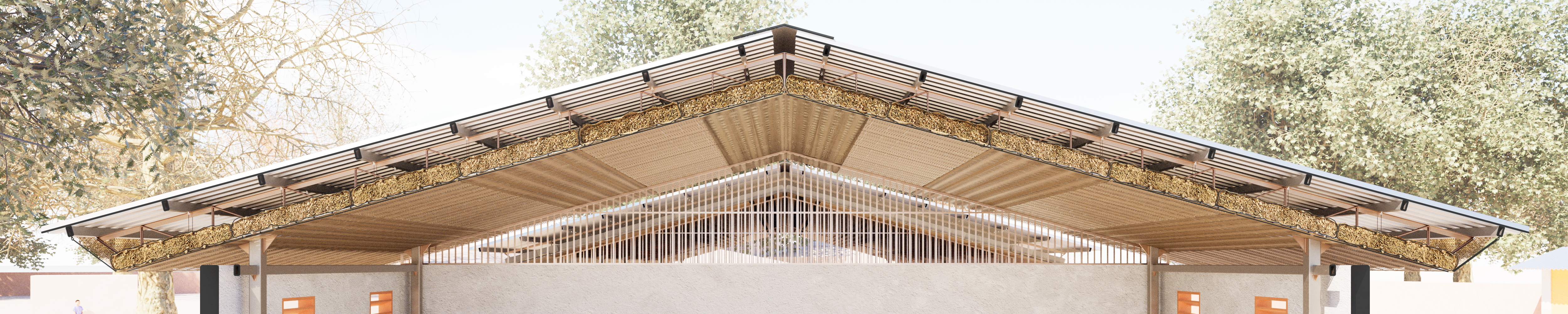
Climatic performance is managed by a multi-stage system beneath a sacrificial skin of corrugated metal, which was selected for its regional reliability and waterproofing efficiency. Solar heat is managed by a deep, cross-ventilated cavity that flushes away radiant heat before it reaches the interior, while the layers below neutralize rain noise. The insulation core consists of a bio-composite mix of Typha fibers for high insulation and crushed peanut shells for thermal mass, treated with borax and hand-packed into tufted jute sacks. This “grown” insulation activates a local micro-economy, turning the construction process into a direct financial injection for local farmers and artisans.

The entire assembly is suspended from the Active Grid, a multifunctional galvanized mesh that supports the bio-composite panels and the breathable bamboo ceiling. This grid also serves as a universal rail for hanging lighting, mosquito nets, and educational aids, ensuring the entire roof remains fully inspectable and maintainable by the community. Because the roof is structurally autonomous, the perimeter walls can be built using any local earth-based masonry. The interior surfaces are finished with white lime plaster to create a “Living Canvas,” a neutral space that invites students to personalize their environment with murals and artwork. This design choice fosters a deep sense of ownership and belonging, allowing the children to transform the physical building into a place they truly own
FINAL THOUGHTS AND CRITICAL REFLECTIONS
Being named a finalist in this competition served as a catalyst for an extensive research period, during which Diego Antonio Bonilla Avila and I delved deep into the territory’s climate, materials, and local customs. Looking back, we recognize that we perhaps followed the competition brief regarding modularity and cost-efficiency too literally. Our commitment to a pragmatic, functionalist approach led us to restrict the project’s formal and technological complexity to ensure absolute feasibility. While the winning entries explored more intricate compositions, our regret is having perhaps over-prioritized function at the expense of a more daring architectural form.
Despite this, the project was an invaluable laboratory where we experimented with new representation techniques and a unique collaborative workflow. The process was both challenging and rewarding, as Diego and I managed the development across two distant parts of the world. Balancing physical meetings with long-distance online sessions across complex time zones allowed us to turn the logistical constraints into a shared creative journey. This experience reinforced our belief that architecture is a process of constant learning and refinement, where the role of the designer is to facilitate a sustainable future for the community.
